The Recipe Card Before the Cookbook
The recipe card before the cookbook traces how household notes travelled into shared collections, revealing what each format preserved and left unsaid.
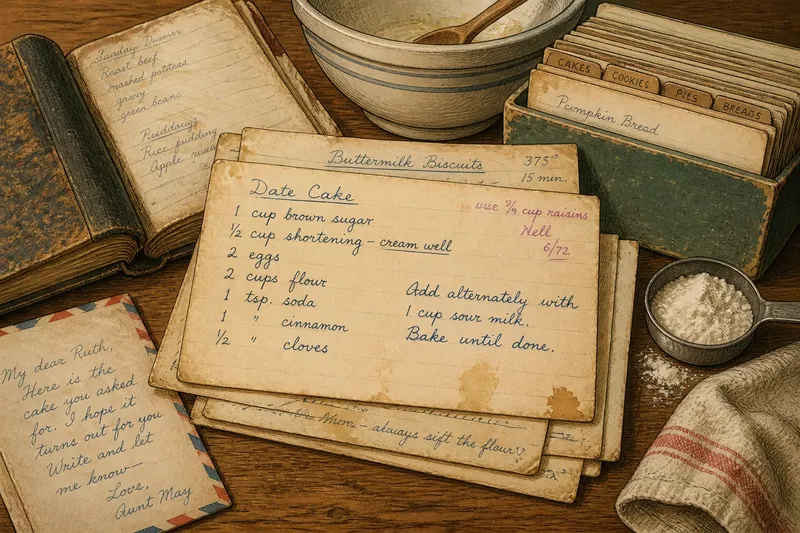
The recipe card before the cookbook was often a scrap of paper tucked into a kitchen drawer, not a polished page bound for sale. Its short lines, stains and handwritten changes carried cooking knowledge from one household to another—and the shape of the note influenced what a later cook could understand.
Household recipe notes
A recipe could be a full set of instructions, but it could also be a reminder for someone who already knew the dish. Household notes often assumed that the reader understood local ingredients, familiar cookware and the cook’s habits. “Bake until done” might make sense to a relative who had watched the dish being made; to another reader, it left too much unsaid.
Cooks recorded recipes in whatever was close at hand: notebooks, loose sheets, letters, household account books or scraps kept near the stove. Some entries named ingredients and quantities; others focused on a distinctive method or useful proportion. The record reflected the cook’s purpose, not an editor’s idea of completeness.
A household note was not necessarily a failed cookbook recipe. It could be an efficient prompt for a familiar routine, designed for one reader and one kitchen. When it travelled, its gaps became visible. The recipient had to ask questions, infer details or adapt the instructions.
Notes shared by hand
Recipes moved through ordinary relationships. A cook might share a method with a relative, copy a neighbour’s cake recipe or send instructions in a letter. Someone leaving home could carry familiar dishes in a small notebook. In these situations, writing joined an existing chain of demonstration and conversation rather than replacing it.
Hand copying made the record personal and selective. A recipient might preserve only the dishes they expected to use, rewrite a recipe in their own words or add a correction after cooking. A card could gather several hands over time: the original writer’s instructions, another cook’s adjustment and a later note about a changed ingredient.
A single sheet was easy to pass across a table or slip into a letter. A bound notebook kept related entries together, but was less convenient to lend one recipe at a time. Neither format was automatically better; each made a different kind of sharing easier.
Recipe card format
Cards made individual recipes easy to sort, lend and rearrange. Unlike a bound notebook, a box of loose cards could be organised by dish, occasion or ingredient. A cook could add a new recipe without rewriting the rest, or take one into another room. That flexibility suited a collection that changed over time.
The compact card encouraged a recognisable layout: a heading identified the dish, a list gathered the ingredients and directions followed in a separate block. This arrangement made a recipe easier to scan while cooking. It also made omissions conspicuous: an ingredient without a quantity or a method without a clear sequence stood out more than it might in hurried prose.
Yet a card’s small space could compress too much. Writers used shorthand, assumed familiar utensils or left out steps they considered obvious. Portability was not the same as clarity; a card could travel farther than the shared context that made its brief instructions intelligible.
Shared recipe collections
When a club, neighbourhood group or other community assembled a recipe collection, the intended reader widened. Contributors chose what to submit and how to describe it; editors then decided how to present those contributions. The result offers a view of that particular collection’s submissions and editorial choices, not a complete record of what every household cooked or valued.
Editors had to decide whether to preserve spelling and wording, standardise ingredient lists, explain unfamiliar terms or retain contributors’ shorthand. Each choice could make recipes more consistent while smoothing away signs of individual voice.
Compilation also changed how a recipe was encountered. In a card box, a cook might search by memory or sort through a familiar personal system. In a shared collection, headings and an index guided the reader instead. The book’s arrangement influenced which dishes seemed related and how easily they could be found.
Imagine a neighbourhood group assembling a booklet. One contributor sends a card that says “cream well”, assuming everyone knows the family’s bowl and method. The editor asks what the phrase means, then adds a brief explanation while retaining the contributor’s wording. A reader unfamiliar with the dish can now follow the intended action, though the note still reflects one contributor’s account rather than a universal definition.
Print and recipe voice
Print gave a recipe a stable, repeatable form: readers of the same edition could consult the same wording. A published recipe could reach people outside the contributor’s circle, giving editors a reason to clarify quantities, sequence and unfamiliar language.
A wider audience could also make recipes sound less like conversation. A family note might address a particular person or refer to a familiar kitchen habit. A published version generally needed to speak to an unknown reader, so it depended less on personal memory and more on what the page explained.
Print did not erase household adaptation. Readers could pencil changes into margins, copy favourites onto cards and pass down their own versions. A published recipe remained a starting record, not a sealed object: ingredients, equipment and tastes differed between kitchens.
What recipe formats omit
Every format preserved some details more readily than others. A card could hold a concise ingredient list but leave little room for the texture of dough or the smell that signalled a dish was ready. A letter could explain why a method mattered, yet bury the recipe among family news. A cookbook could provide order and an index while concealing the exchanges and revisions behind the final wording.
Handwriting could carry clues. A crossed-out amount or a note in another colour showed that someone had revisited the recipe. Stains and soft folds suggested frequent handling, though they could not explain exactly what happened in the kitchen. Such marks give a record texture; they cannot replace missing instructions.
For a cook reading an old family recipe, the useful question is not simply whether the note is complete. Ask what knowledge its first reader was expected to bring. “Use the usual tin” may point to a familiar household object; an unexplained local ingredient may hint at where the recipe belonged. Those clues can help identify what needs checking before cooking.
Choosing a recipe format
A card suits a recipe that needs quick access and frequent adjustment. A notebook suits dishes connected through family occasions or personal notes. A digital document can be searched and copied; a printed collection offers a fixed version to keep or give. Choose according to how the cook expects to use and share the record.
Write for the person who will receive it. Name ingredients clearly, separate them from the method and describe useful cues: a mixture turning glossy, a surface becoming crisp or a sauce thickening enough to coat a spoon. If a step depends on a particular pan or local ingredient, say so rather than assuming the next cook will recognise it.
Keep a recipe’s history visible when it matters. “Adapted from Aunt Mara’s card” or “changed after using a smaller dish” distinguishes inheritance from later adjustment. That context helps future cooks see which parts came from an earlier household and which reflect a later cook’s choices.
Why keep the old card?
The recipe card before the cookbook shows how cooking instructions could move through different records. A private note served a familiar reader; a card made a dish easy to carry; a community collection brought selected contributions together; print gave wording a repeatable form. Each format changed what readers could find and understand, without telling the whole story of cooking in every household.
When you write down a dish, decide what the next cook needs to see. A clear heading and method help them begin; a sensory cue or a note about the dish’s source gives them context. The most useful record need not be polished. It should make its instructions clear and distinguish what is remembered from what a later cook has changed.